

Registration is closed
Stay tuned for updates on social media:

.svg)
.svg)
This hackathon focuses on creating digital tools that make public services more accessible, understandable, and user-friendly for community residents, including internally displaced persons (IDPs).

About this Hackathon
Communities are facing the need to adapt public services to new realities: an increased number of IDPs, limited resources, complex procedures, and overloaded communication channels.
The “Public and Government Services” Hackathon brings together IT professionals, civic activists, and community representatives to co-create digital solutions that:
.svg)
improve access to services
strengthen communication with residents
increase transparency and trust
support more efficient interaction between communities and people
Challenges teams will work on
During the hackathon, teams will work on challenges based on priority community needs, including:
digital navigation services for public and municipal services for residents and IDPs
platforms informing residents about available services, support, and opportunities
feedback tools connecting citizens with local authorities
solutions increasing transparency of processes and decision-making
services simplifying interaction with local institutions
Who should join

IT
IT developers, engineers, and analysts

UX/UI
UX/UI and service designers

startups
Civic-tech startups

activists
Community representatives and civic activists

Communities
Professionals working with public services and IDP integration
Speakers and mentors

speaker
Cheong Eun
Kang
Kang
Project Officer (Transition and Recovery) at IOM

speaker
Alissa
Bankovska
Bankovska
President of FIABCI-Ukraine. Founder of SYNCHRO SPACE — an innovation hub for cities. Co-founder of voice of space — a spatial development agency.

speaker
KHRYSTIA
PASTUSHCHENKO
PASTUSHCHENKO
Executive Director of the Association of Small Cities of Ukraine.

speaker
mentor
LIDIIA
PASHCHUK
PASHCHUK
Expert in entrepreneurial ecosystem development, support for small and medium-sized businesses, innovation, and strategic marketing.

speaker
mentor
Denys
Yaroshenko
Yaroshenko
SEO SuoQ. Specialist in the development and implementation of electronic queue management solutions

facilitator
Olga
Mashtaler
Mashtaler
Co-founder and host of the e4ebusiness camp, a series of business camps for entrepreneurs. Coordinator of the Urban Innovation Platform. Facilitator at Smart City Lab.

mentor
Mykola
Babak
Babak
Business сonsultant, appraiser (REV), Project development officer at Novoheat AB. Expert in strategic communications, PR, and public image building for projects and brands.

mentor
Dmytro
Tkachov
Tkachov
Independent consultant on community and business development. Expert in digital solutions and management processes.

mentor
Kateryna
Pylypchuk
Pylypchuk
Vice President of FIABCI-Ukraine, Co-organizer of Rebuild Green 2030. Expert in urban development and project management.

mentor
Vadym
Petrunin
Petrunin
CEO iHUB. Expert in innovative entrepreneurship, startup development, and ecosystem building to support businesses and veterans.

mentor
DmytrO
Korniienko
Korniienko
Co-founder of the engineering school #brobots. Developer of technical educational workshops.
Participation Format
3
days
Intensiveteamwork
Pitching solutions to the jury
Mentoring
Pitch preparation
Expert sessions
Prototype development
What Is Provided
to Participants
to Participants

Workspace

Technical equipment

Meals

Accommodation for participants from other cities

Ongoing mentor support
Prize Fund
Join, win, and bring your project to
life — make an impact on community development!
life — make an impact on community development!
At each of the three hackathons, the jury will select two winning teams to receive financial support from the International Organization for Migration (IOM) for further development of their solutions (6 winners in total)

10 000 EUR

5 000 EUR
Challenge from communities
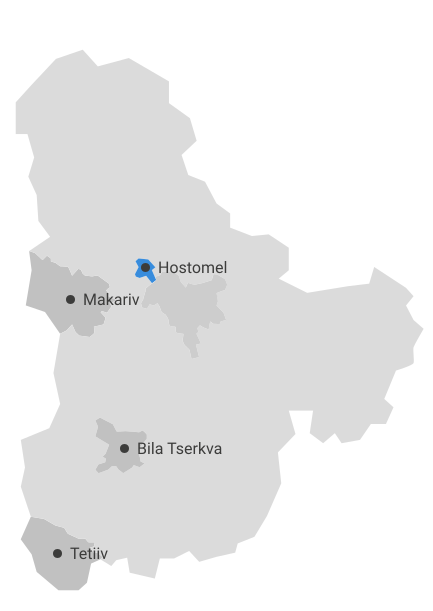

Kyiv region:
Hostomel
Hostomel
Digitalization of School Meal Management Processes in the Hostomel Community
Educational institutions in the Hostomel community manage daily meal accounting — a critical operational process that is currently handled mostly manually. Data is transferred in multiple formats, increasing the risk of errors, complicating reporting, and creating additional administrative burden for teachers and staff.
The community’s challenge is to design a concept and prototype of a digital solution that automates meal management processes and makes them transparent, accurate, and manageable.
The expected outcome is a web or mobile solution enabling daily data entry, automatic aggregation, and reporting for educational institutions and governing bodies. The solution should improve management efficiency, reduce administrative workload, and enhance the quality of public services within the community.
The community’s challenge is to design a concept and prototype of a digital solution that automates meal management processes and makes them transparent, accurate, and manageable.
The expected outcome is a web or mobile solution enabling daily data entry, automatic aggregation, and reporting for educational institutions and governing bodies. The solution should improve management efficiency, reduce administrative workload, and enhance the quality of public services within the community.
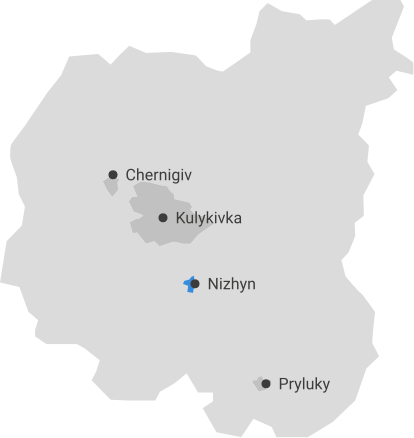

Chernihiv region:
Nizhyn
Nizhyn
Online Platform for Local Businesses, Services, and Entrepreneurs of the Nizhyn Community
The Nizhyn community is home to active entrepreneurs, small and medium-sized businesses, craft producers, and service providers. However, information about local businesses remains fragmented, poorly visible, and not integrated into a single digital space, limiting interaction between businesses, residents, and local authorities.
The community’s challenge is to design a concept and prototype of a digital solution that increases the visibility of local businesses and strengthens the community’s economic activity.
The expected outcome is an online platform with an interactive business map, business profiles, and user-friendly search and interaction tools. The solution should serve as a digital ecosystem that supports entrepreneurship, stimulates the local market, and enhances the economic resilience of the community.
The community’s challenge is to design a concept and prototype of a digital solution that increases the visibility of local businesses and strengthens the community’s economic activity.
The expected outcome is an online platform with an interactive business map, business profiles, and user-friendly search and interaction tools. The solution should serve as a digital ecosystem that supports entrepreneurship, stimulates the local market, and enhances the economic resilience of the community.
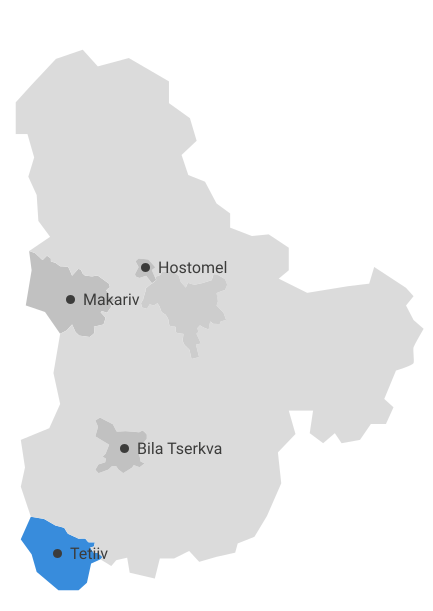
Kyiv region:
Tetiiv
Tetiiv
Digital Ecosystem of Municipal Services of the Tetiiv Community
The Tetiiv community provides residents with a wide range of administrative, social, educational, and utility services. Currently, these services are delivered through fragmented channels and formats, creating information gaps, paper-based bureaucracy, and additional burdens for both residents and local government staff.
The community’s challenge is to design a concept and prototype of a digital solution that brings municipal services into a single, user-friendly system.
The expected outcome is a web-based “single digital window” platform offering centralized access to services, online applications, a personal user account, and transparent interaction between residents and the local administration. The solution should simplify access to services, reduce queues and paperwork, and improve efficiency, transparency, and trust in local governance.
The community’s challenge is to design a concept and prototype of a digital solution that brings municipal services into a single, user-friendly system.
The expected outcome is a web-based “single digital window” platform offering centralized access to services, online applications, a personal user account, and transparent interaction between residents and the local administration. The solution should simplify access to services, reduce queues and paperwork, and improve efficiency, transparency, and trust in local governance.
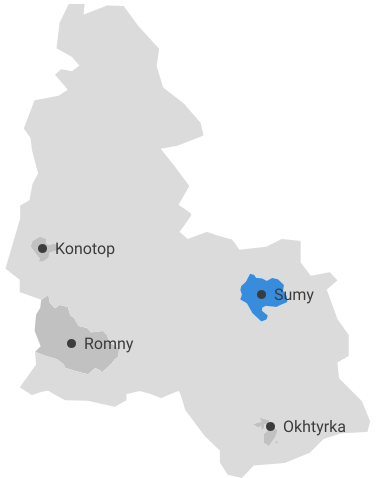

Sumy region:
Sumy
Sumy
Digital Platform for Economic Resilience: «From Local to Local»
The Sumy community operates under wartime challenges and limited access to external markets, increasing the need to strengthen internal economic resilience. While local producers and businesses are active, they remain isolated, and residents often lack access to information about local products and partnership opportunities.
The community’s challenge is to design a concept and prototype of a digital solution that activates the local economy and strengthens interaction between producers, businesses, and consumers.
The expected outcome is an online B2B/B2C platform that connects local producers, business partners, and residents, enables product and service presentation, partnership search, and economic recirculation. The solution should support small and medium-sized enterprises, build local value chains, and enhance the community’s economic resilience.
The community’s challenge is to design a concept and prototype of a digital solution that activates the local economy and strengthens interaction between producers, businesses, and consumers.
The expected outcome is an online B2B/B2C platform that connects local producers, business partners, and residents, enables product and service presentation, partnership search, and economic recirculation. The solution should support small and medium-sized enterprises, build local value chains, and enhance the community’s economic resilience.
Registration is closed
Stay tuned for updates on social media:
.svg)
КОНТАКТИ:
info@hub-synchro.space
info@hub-synchro.space